

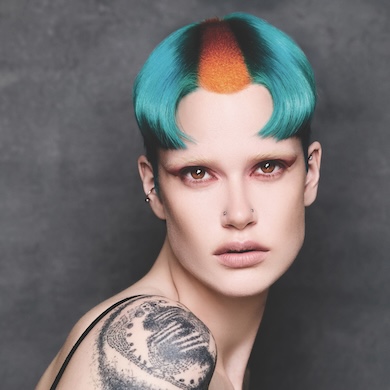
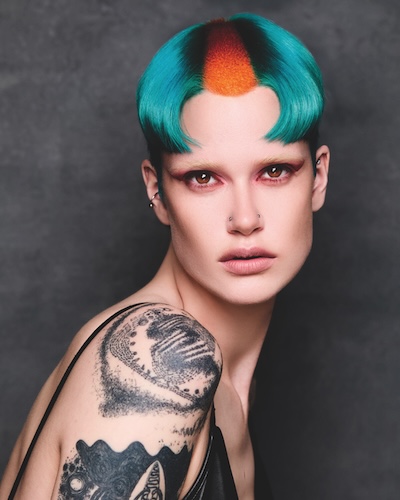
As shorter hair continues to be in high demand, buzzcuts are making a comeback—ranging from skin fades and low tapers to French crop fades. And thanks to the shift toward more gender-fluid styling, these styles are incredibly versatile and easily tailored to a wide range of clients. “Hairstylists can create more gender-fluid haircuts by first understanding the parameters of binary shapes,” says Darren Jansen, a short hair expert at Pomme Salon Toronto and a L’Oréal Professionnel ambassador. “The next step is allowing themselves the freedom to deconstruct the shapes and cater them to the individual.”
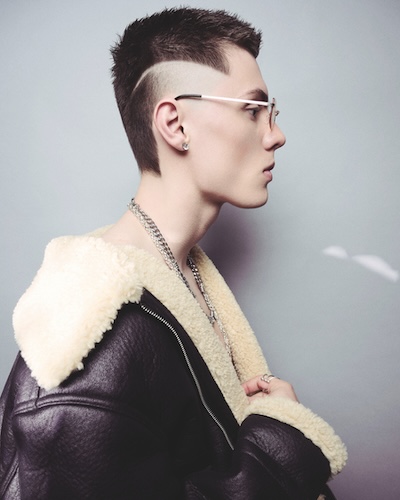
While he has received requests for various types of short hairstyles, Jansen says the haircut he has seen most often is the burst fade, which is an extension of the mullet that wraps around the ear as opposed to just being faded in the temple area. “This is a very nice and natural transition from clients that were rocking some level of a mullet. It’s something that’s familiar, but also enough of a change that they feel like it’s a progression.”
Beyond the Buzz
Elevating a haircut comes down to more than just clean fades and the right tools. It’s about understanding a client’s hair texture and tailoring the look to best suit their face shape. According to Scott Ramos, founder of Saint Barbershop in Winnipeg, Man. and a global educator who works with brands such as Andis and STMNT, the ideal face shape for these cuts is a perfect oval.
“You kind of want to try to manipulate the hair so it brings the face closer to that oval,” he says. “Some people have cone-head shapes, in which their mastoids protrude and their head sort of comes to a point.” He says that with these types of heads shapes, it’s important to keep more length near the parietal area to create more of a boxy shape. To customize the cut according to your client’s head and face shape, Jansen believes that a good haircut always comes down to a thorough and detailed consultation, which also means discussing the hair’s texture and density, as well as the client’s lifestyle and comfort level. “If you’re proficient at creating all shapes in haircutting, it gives you the most amount of options to offer your clients,” he says. “Whether they’re binary or non-binary, it’s important to make sure that the individual feels the most confident when they leave your chair.”
Tools of the Trade
Since haircuts are all about the proper execution—regardless of length—it’s important for hairstylists and barbers to understand what kind of haircut the client wants and then closely consider their hair texture before reaching for any cutting tools. When it comes to perfectly executing a short haircut, Ramos says it’s all about keeping things simple. “Creating hard lines will create hard times,” he says. “A fade is a series of lines, so a lot of people, especially those in viral videos, feature barbers going in and just drawing in, turning the trimmer around, and really pressing in these bald lines. It looks really cool on video, but if you don’t know how to remove these lines properly, then your fade is going to have hard lines.” Jansen says he prefers to do scissor work first to build out the shape and silhouette. “I think of fading as debulking, and I can add the shape there after I figure out the way I want it to look.”
PRO TIP
TO AVOID CREATING HARSH LINES, RAMOS SUGGESTS USING YOUR CLIPPER WITH THE LEVER OPEN AND CREATING A FINGER’S WIDTH ABOVE YOUR INITIAL GUIDELINE AND PARALLEL. THEN, SLOWLY CLOSE YOUR LEVER AND FADE DOWNWARDS UNTIL THE FIRST LINE IS GONE, OR USE A NUMBER ONE GUARD OPEN TO REMOVE THAT LINE BY FADING DOWNWARDS.
Knowledge is Power
Repetition is key when it comes to gaining the confidence to successfully execute a fade on clients with different hair textures. Ramos says hands-on experience is best, and while working on a mannequin helps, practicing on a human head is better. “That way, they can take the techniques and tips that we show them in person and be able to apply them,” he says. “After that, it’s really just about putting in the reps.” Ramos, who recently cut the hair of his friend Brady Oliveira, the lead running back for the Canadian Football League’s Winnipeg Blue Bombers, notes that different hair textures require different techniques. He says that for Oliveira’s coarse hair, which has loose curls, he uses a number five against the grain for the whole top. “Then, for the sides, I use my Andis Recon Clipper.”
Pop of Colour
Hair colour can help bring out the dimension in a faded cut or add a layer of playfulness. Ramos says he continues to see men lightening their hair and toning it to achieve a cooler shade, which they often pair with buzzcuts. “I think what I’ve seen the most is guys just getting some highlights when they wear that nice, natural middle part,” he says. “Or some guys with loose curls will put in what looks almost like frosted tips.” Jansen adds that he’s been seeing more vanilla blondes, sand and beige tones, along with shades that look a little more “naturally unnatural.” “It looks super clean when you have freshly lightened hair with a global blonde or a bleach-out,” he says. “But my favourite look is when the haircut has grown out for about three weeks. You get a little bit of that rooted look—somewhere between three and five weeks—and the roots have started to show, especially when the roots are darker than the lightened hair. When you toss the fade in on that, the depth you get between that lightness of the skin coming into the fade is so dynamic. Adding a little bit of a shadow into some darkness of their natural tone that then goes into the blonde looks amazing.”
“A NECK TAPER ON A PIXIE HAIRCUT OR A PEEK-A-BOO UNDERCUT IS A GREAT WAY TO INTRODUCE CLIPPER WORK TO SOMEONE WHO MAY NEVER HAVE CONSIDERED IT OTHERWISE. ADDING FADING AND CLIPPER WORK TO YOUR ARSENAL OF TOOLS ALLOWS YOU TO PROVIDE A DYNAMIC FLARE TO A CLIENT THAT GIVES THEM A SIGNATURE LOOK.” — DARREN JANSEN, SHORT HAIR EXPERT AT POMME SALON TORONTO AND L’ORÉAL PROFESSIONNEL AMBASSADOR
Game Changers
With the popularity of the FIFA World Cup this past summer, both Ramos and Jansen agree that many of this season’s haircut trends have been influenced by soccer players. While Ramos says that soccer players have some of the most powerful and influential haircuts, Jansen adds that the burst fade was by far the most popular haircut seen across this year’s World Cup games. “If you look at one football team, it’s like 40 per cent of the team rocking this haircut,” he says. “I was also surprised to see a lot less hair colour in FIFA than usual.” According to Jansen, now is the most fun time to be a hairstylist or barber due to the inclusivity of styles and trends.
“Not too long ago, it was very structured and had very strong parameters,” he says. “If you had a man sitting in your chair, you had to do it one way—it had to be very square and that’s the only thing you could do. If you had a woman in your chair, or somebody who wanted something a little bit softer, you had to be very round. Now, you get to sort of mix and match many of these things to create these very dynamic looks.”
TEXT: LUCY MAZZUCCO, PHOTO: HAIR: DEXTER JOHNSON AT TONI&GUY LONDON, U.K., MAKEUP: ADNANA CHIRILA, WARDROBE STYLING: BORNA PRIKASKI, PHOTO: DAVID MANNAH, HAIR: CONTESSA 37 FINALIST, CANADIAN COLOURIST, DARA MAN, KROMA SALON, KING CITY, ONT., MAKEUP: RENNE MOONEY, PHOTO: NATASHA GERSCHON


Comments are closed.