

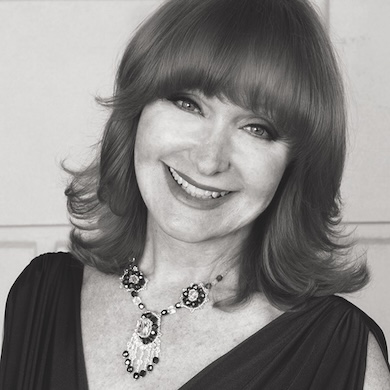
Award-winning hairstylist Vivienne Mackinder is challenging stylists to level up their services by transforming consultations into open dialogues about cut and colour in her new class, The Art of Design & Transformation. We caught up with the renowned artist to learn more.
From your experience working with industry legends like Vidal Sassoon and Trevor Sorbie to your education roles with brands to launching your own platform, what is motivating you at this stage in your career?
My current focus is on addressing the silent crisis of everyone teaching technique, but no one taking the time to talk about philosophy or psychology. From everything I’ve studied over the years, it’s 80 per cent psychology and 20 per cent mechanics—and the 20 per cent is what our industry focuses on. When you look at stats, 75 per cent of new clients are not coming back to the salon, and if you look at the amount of people with long hair out there, it’s like, what is the problem? Because I bet if you interviewed most women out there, they would say the reason they have their hair so long is because no one ever gave them advice they could trust. Long hair is fine if it’s beautiful. It doesn’t matter what your age is. If you can wear it, then that’s fine. But if you can’t, that’s a problem. In these situations, I use AI to see what shape and style would best suit my client’s face shape and needs.
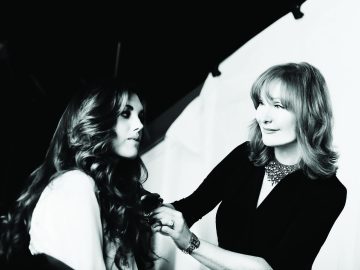
You use AI during your consultations? Tell us more about that.
I do it all the time. For example, if I like her lighter around the face, but I’m also being really sensitive to the fact that she wants something low maintenance and likes healthy, shiny hair. I’ve trained the AI. For example, soft versus bold, like the nude makeup, and so on. But it’s using all my own hair. I’ve improved on it a lot since it’s so hard to get rid of mannequin hairlines. [When using AI,] I’ll use the client’s face or the face from a photo shoot but the hair isn’t touched.
Within 20 years, 90 per cent of jobs out there will have gone and it will be a very different world to live in. They’ve got robotics doing surgery now, and seeing how this whole world is pivoting and the intelligence that we have access to is incredible. Eventually, a robot will likely be able to do hair, but not with the human touch, connection, and the 80 per cent psychology that’s associated with caring for and putting the right look on the right person.
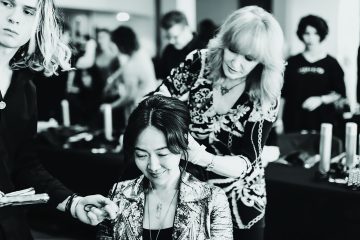
“THE IRONY IS, I DIDN’T GO OUT THERE THINKING, ‘HOW CAN I HELP PEOPLE MAKE MORE MONEY?’ I WAS THINKING, ‘HOW CAN I HELP PEOPLE SERVE BETTER, CREATIVELY AND TECHNICALLY?’”
I understand that you also use a personality quiz during consultations.
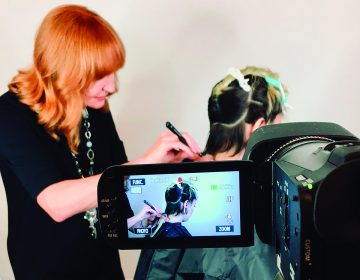
I do believe in that 80 per cent psychology part. You can prebook, do marketing and special promotions, but it doesn’t really matter. You can do a brilliant haircut and brilliant colour, but if you haven’t captured the personality, you’ve completely missed it. I talk about how the artist sees something through a creative filter. The “entertainer” is, “How do I please?” The “technician” is a perfectionist. The “puppet” is probably where most of our industry lives. “What do you want today? How many inches do you want cut off? The same as last time?” I have the Wheel of Femininity, which no one talks about. How feminine do you want to be and how much do you not?
What are some other factors to consider during the consultation?
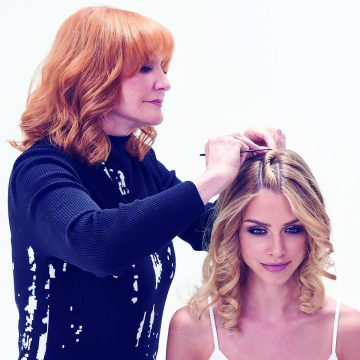
We talk about body type, which nobody talks about. This is where I will never put a horizontal line on a horizontal lady. I’m talking about length of torso and volume. I will never do a blunt line; I’ll do a round line so I can elongate there, rest, raise it at the shoulder, and create tons of softness through there. And I would never do a very short style that creates a tiny head on a bigger body. You need [clients] to stand up. I do this in a very elegant way and don’t look at the person—I look at their reflection and say, “I just want to balance the length to your body type.” That’s really important. I want the hairstyle to fit, head to toe.
What are other things you would recommend doing to help customize the consultation and build business in the salon?
Imagine you’ve got a client sitting in your chair who says, “Gosh, I love my hair.” You’re going to say, “Would you mind giving this card to the first three people who compliment you on your hair?” That’s what I do, and I give them references.
I always say that there are three things a woman needs from you: To be safe, to be seen and to be heard. Now, if you don’t deliver on those three things, you will be a victim to the changing world. But if you’re smart enough and recognize it’s coming—and that it’s coming sooner than we think—then you can have an amazing experience and be a destination where it’s almost like the spa experience: the holistic experience meets the execution of the hairstyle.
What are some key takeaways you’re hoping people take away from your classes about this?
A whole change in how they see their clients and to start to understand those archetypes and how they conserve or sabotage. There’s such an untapped market out there where it’s just long hair that’s lacking shape. That’s where hairdressers come in.
As a past Contessa judge, how would you describe the talent in Canada and what advice do you have for this year’s entrants?
I’ve always had a soft spot for Canada. I lived in Canada, in Vancouver, for three years. So, I’ve always loved the country and really enjoy the people. I think there’s a lot of talent, but I’m going to quote Trevor Sorbie and say that there’s a fine line between creativity and bad taste. Sometimes, people get so creative that they don’t know how to edit. I think creativity should always come under the umbrella of fashion, unless you’re truly doing a fantasy competition. It still has to be tasteful, right?


Comments are closed.