

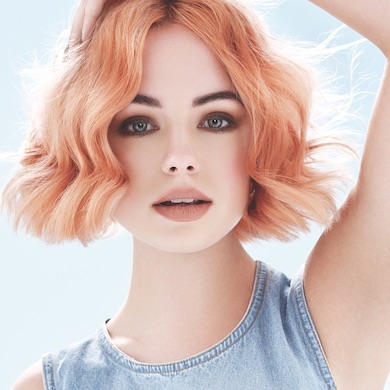
As colour trends continue to be centred around warmer tones, it should come as no surprise that Pantone’s Color of the Year, Peach Fuzz, is the quintessential shade that blends together hues of orange, yellow, pink and red.

“To me, Peach Fuzz is warm, soft and sweet,” says Brigitte Castonguay, a Montreal-based colourist and member of Wella’s design team. “We kind of need this softness right now in our everyday lives, and you can use it on almost every client since it suits a lot of people.”
“With hair trends getting warmer, Peach Fuzz makes sense,” adds Tasha Parker, a hairstylist and global Redken artist based in Fredericton, N.B. “It’s not just for blondes, but also for brunettes with really dark, tone-on-tone colour who want to be lighter, brighter and a bit warmer. It’s a great transition for them into spring and summer.”
PRO TIP
PEACH FUZZ CAN BE THE PERFECT WAY TO TRANSITION SOME OF YOUR CLIENTS WHO EMBRACED THE COWBOY COPPER TREND IN THE FALL, SINCE THEIR LIGHTENING PROCESS WILL OFTEN RESULT IN A SHADE THAT’S A VARIATION OF THE PANTONE COLOUR
Taste Test
While some clients may think that a fashion colour like Peach Fuzz won’t work for them or their lifestyle, it’s up to you as the expert to show them the versatility of this trendy shade.
“I think some hairstylists might also be nervous about it because of the paleness and pastel of it,” says Parker. “Once they see how they can adjust it for different people, it’s pretty versatile.”
From all-over colour application and balayage to panelling and peekaboos, there are endless options that can help make this shade more approachable for a range of clientele.
Before deciding on your placement, it’s important to have a thorough consultation with your client to ensure that you’re both on the same page and also so they can understand the level of commitment and maintenance involved.
“Find visuals and examples of the shade on social media,” says Parker. “A lot of people need to see it to understand what it looks like. Seeing it on coppers, blondes and brunettes helps clients understand the versatility and what it can look like on them.”
Next is determining the shade of Peach Fuzz that’s right for them. While some clients will want to take the plunge and get as close to the Pantone swatch as possible, others will be open to more of an interpretation of the trend.
“For the consultation, I like to focus on the client’s skin tone and eye colour,” says Castonguay. “I look to see if they have more blue or green veins and at their skin’s undertone. I’ll ask them about their wardrobe and what colours they like to wear, their jewelry (if they wear gold, rose gold or silver), if they wear glasses and the colour of their glasses. I’ll ask about anything that’s going to be close to their hair or skin, but I’ll also ask about anything they don’t like, too. Place colour swatches near their faces to show your clients what the colour will look like.”
“Peach Fuzz works for a lot of skin tones,” adds Parker. “You can always add a bit more pink or peach to it, depending on the skin tone, or you can do different variations of it with champagne or brunette tones for more a bronde effect. It’s pretty versatile with blondes, brunettes and coppers.”
“PANTONE IS AN INSPIRATION—IT DOESN’T HAVE TO BE THE EXACT SAME COLOUR YOU CREATE. IF A CLIENT SHOWS YOU THE COLOUR, LOOK FOR VARIATIONS OF THAT SHADE AND HELP THEM FIND SOMETHING THAT WILL WORK FOR THEM. IT’S MEANT TO BE AN INSPIRATION, NOT A COPYCAT.” — BRIGITTE CASTONGUAY, COLOURIST AND WELLA DESIGN TEAM MEMBER, MONTREAL
Taking a Bite
Once you’ve determined the right shade and placement, it’s time to apply the colour. “For really dark or damaged hair, I’ll put it in foils,” says Castonguay. “I’ll go freehand for lighter, natural hair that has the potential to get as light as it needs to.”
While both colourists recommend lightening hair to a level nine or 10 for optimal results, a Peach Fuzz-inspired tone can also be achieved on a level eight. “For clients who are always lightening their hair, keep them at a level 10, but level nine is also nice because there’s still a bit of yellow there that will work well with peach,” says Castonguay. “Level eight is still really yellow, so I would pre- tone first. Working with a level eight is possible, but the result will be darker or warmer.”
“At a level eight, you’ll want to make sure there’s some gold in there to support the end result,” adds Parker. “You’ll want to work with golds, reds, yellows or oranges.” Next up is maintenance. Parker often recommends that the client come back for a toner or gloss every four to eight weeks, depending on their lifestyle and how often they shampoo their hair. However, for the first visit, she suggests pre-booking them around the six-week mark. “The in-between appointments are important in helping them understand how often they’ll need to come back or what they’ll need to do at home to preserve their colour,” says Castonguay. “Some clients hate having to maintain their colour at home with toners, so they prefer to come back to the salon, while others may have a smaller budget and want to be able to maintain it at home themselves with a colour mask.”
“Make sure they’re using a colour- protection shampoo and conditioner,” adds Parker. “Using heat protection is also important since heat styling will fade the colour. Also, wear a hat to protect hair from the sun.”
PRO TIP
FOR MORE LONGEVITY AND DEPTH, CONSIDER USING A DARKER LEVEL, SUCH AS A LEVEL SIX OR SEVEN, AND ADDING CLEAR TO DILUTE THE TONE FOR A MORE PASTEL RESULT
According to Pantone, Peach Fuzz is a shade that “resonates with compassion, offers a tactile embrace and effortlessly bridges the youthful with the timeless.”
TEXT: VERONICA BOODHAN, PHOTO: HAIR: ANDREW SMITH, ANDREW SMITH SALONS, U.K., MAKEUP: LOUISE LEREGO, PHOTO: RICHARD MILES. ADOBE IMAGES


Comments are closed.