

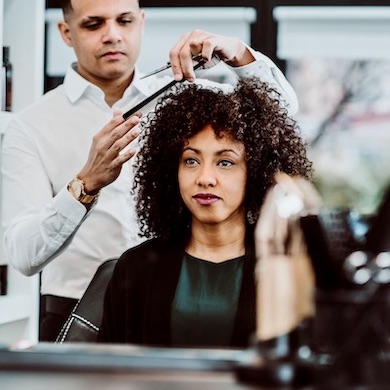
Long gone are the days when stylists would turn away guests with hair types and textures they don’t know how to service. In today’s day and age, it’s a known fact that most people have some variation of texture in their hair. It should come as no surprise that many people are becoming increasingly interested in not only embracing that texture but also for their hair while addressing common concerns and learning the best ways to service their individual hair needs.

“It’s estimated that 60 per cent of the global population has curly hair,” says Lauren Wilde, a Wella design team artist, curl specialist and owner of Rose and Onyx Hair Company in St. Albert, Alta.
“From a business perspective, that’s an finding stylists who can help care enormous part of the industry that many salons aren’t currently reaching.”
Being able to work with clients with any hair type or texture is vital in creating a diverse, inclusive and welcoming salon environment. However, it can provide the added benefits of helping to build business by increasing and attracting new clientele and building long-lasting relationships with clients.
Setting the Standard
Generally speaking, Canada is quite diverse when it comes to its population, which consists of a melting pot of different cultures, ethnicities and religions. However, the country continues to fall behind in offering inclusive education for all hair types. While the U.S. has made some progress since the pandemic, Canada has been slow to catch up.
“I’m from Montreal, which is also very multicultural, so I encounter people from all different backgrounds,” says Sandrine Takam, a Montreal-based hairstylist and Matrix artist and educator. “Personally, I want to be able to offer my services to whoever may be interested in them.”
“As stylists, we have to keep in mind that curly hair has only recently been more talked about or ‘trending,’” she adds. “A lot of us grew up with the mentality that our natural hair wasn’t nice and we shouldn’t wear it, so now when a client with curly hair has the courage to come back into the salon, they don’t know who to trust.”
Takam says it’s up to stylists to not only educate themselves on how to properly care for and work with textured hair but also help make clients feel comfortable. A great place for stylists to start their curly- and textured-hair education journey is by realizing that clients need to know that you have the knowledge and that you aren’t afraid of their hair.
“IT’S ALL ABOUT EMBRACING NATURAL HAIR TEXTURE, AND THIS MEANS BUILDING UP YOUR EDUCATION AND LEARNING MORE ABOUT THE THINGS THAT YOU MAY NOT BE COMFORTABLE WITH. YOU NEVER WANT TO BE IN A SITUATION WHERE YOU DON’T KNOW HOW TO WORK WITH SOMEBODY’S HAIR TEXTURE, SO IT’S VITAL TO FAMILIARIZE YOURSELF WITH THE APPROPRIATE SERVICES [FOR DIFFERENT HAIR TEXTURES].”— CINDY DUPLANTIS, CELEBRITY STYLIST AND OLAPLEX AMBASSADOR, MISSISSAUGA, ONT.
Meeting the Demand
Although the importance of offering curly- and textured-hair services may seem obvious to some, others may not realize that the investment in textured- hair education can not only help diversify your skill set and create an inclusive salon environment but also help from a business standpoint.
“Given that a large portion of the population has textured hair, catering to this demographic is essential,” says Cindy Duplantis, an Ontario-based celebrity stylist and Olaplex ambassador. “The trend of embracing natural hair texture isn’t going anywhere, and this shows the importance of providing services that accommodate everyone.”
With an overall lack of education on curly hair in the industry, Wilde created The Art of Waves & Curls, a class she teaches with Wella. “I remember when I first started educating and training myself in textured-hair services, I was told that it was going to be a floodgate that would never shut,” she says. “They were right. The demand is enormous and has grown to an exponential level.”
She adds that with her textured- hair education and services, she has developed long-term relationships with her clients, with some travelling from outside of her city (and even the province) to get regular services done. “It can be hard for clients to find a stylist they like who knows how to work with their hair,” she says. “A lot of them have trauma from previous hair services, so once they find somebody who knows how to work with their hair, they really do stick with you and become some of the most loyal clients we have.”
“At some point, you may start losing clients if you’re not inclusive to all textures,” adds Ethan King, a Goldwell national artist and global curl educator based in Austin, Texas. “There’s a need for this in our industry. I have clients flying to me from other cities, states and countries. These hair services have more longevity [for the client] and have opened my availability to take more clients. If you take more clients, then this brings you more opportunity for growth and you can continue to expand your business.”

Benefits of Education
It goes without saying that education is paramount in being able to offer services for curly hair. If you are still skeptical about the benefits or don’t see how it can add value to your business, think again.
“It adds to your versatility as a stylist. I’ve had many clients come to me and say that they’ve had stylists know how to style their hair but not know how to care for it. When you really know how to care for curly hair, one person can send you 10 people. Being able to treat and teach clients how to work with their hair, you can give them that flexibility. It builds a strong bond, and that’s good for everyone.” — Adina Sherman, Texture Expert And Owner Of Curly Girls Studio, Toronto
“There are many benefits of curly- and textured-hair education. Working with curly-haired clientele is some of the most rewarding work I have ever done. It’s changed the way I look at my career and the amount of enjoyment I get from it. This can be life-changing for people with curly hair, so it’s a very rewarding experience that I’m happy to have had.” — Lauren Wilde, Curl Specialist And Owner Of Rose And Onyx Hair Company, St. Albert, Alta.
“There’s so much education available now, whether it’s through different brands that have products that cater to curly and textured hair or other stylists who are specialized in curly hair and offer those kinds of services. If you look, you will find it.” — Sandrine Takam, Hairstylist And Educator, Montreal
“It’s important to always continue your education in this industry and grow with new techniques and styles. If you don’t, you can become bored and uninspired. Stylists and salon owners need to be open-minded right now. Sometimes, it can be hard to reimagine your business or change your service menu because it can be scary to learn new things, but taking curly-hair education is a great way to implement these things.” — Ethan King, Hairstylist And Global Curl Educator, Austin, Texas

Let’s Talk Treatment
Starting the journey to becoming more comfortable and trained in styling curly and textured hair can seem daunting, but experts share that you’re not alone. Many hairstylists who start this journey have a lot of the same questions,
so understanding these common concerns—among both stylists and clients—can be a great place to start.
A common concern faced by clients with many different hair types and textures is frizz. Determining where the frizz is coming from is vital in understanding the problem before coming up with a solution.
“Does the client brush out their curls or coils? Are they running their fingers through it? Is their hair fine? These are all big questions to ask and things that can cause frizz,” says Duplantis. “As a stylist, you have to break down these things in order to figure out what your client’s hair needs. Usually, it’s one of two solutions: moisture or repair. The client’s hair can be naturally a lot drier and more porous or it can be damaged from chemicals, heat styling, the environment or even medications.”
“There is always a balance of products you need in the hair,” she adds. “One part is moisture and the other is hold, and it’s only after dissecting what they need that you can make the proper recommendation, based on if they need more hold because their hair is breaking apart and the curls aren’t staying together, or more moisture due to the act that their hair is porous and frizzy because it’s looking for moisture.”
While frizz and dryness can be inevitable with curly hair, it’s all about how you and the client treat the problem. “Most of the time, proper hydration, application and styling are key to achieving hydrated and shiny curls,” says King. “I always recommend that clients have a balance of hydration and protein treatments for at-home use.”
Hydration and moisture are always top of mind for curly hair, as a lack of both can cause a lot of the common concerns that clients may be facing. “With my wavy-haired clients, they not only need hydration, but also hold and control, so I opt for a gel in their routine,” says Wilde. “For my curly- and coily-haired clients, hydration is the main focus there, so we look for products that are creamier, buttery and replenishing.”
“We always need to think about sending our clients home with the proper products to use, but we also have to
keep in mind that if the clients’ hair needs serious attention, there are some salon treatments and products that can only be done by professionals,” adds Duplantis. “If their hair is in desperate need of treatments for hydration, we need to make a schedule that fits their needs, time and budget. This is a great way of building business because treatments aren’t just a cash grab. When we are honest with our clients and help them understand why they need these treatments, they notice a difference, usually after the first one, and keep up with them.”
When working with curly hair, it’s important to fully understand your client’s hair since there are other attributes that can help you best serve your clients other than just their curl type or pattern.
Determining whether your client has low or high porosity can also help when it comes to treating a lack of hydration and moisture and can help determine the best products to use for their
hair concerns.
“When we’re looking at the curl type itself, we have to subcategorize from there,” says Wilde. “What diameter of hair are we dealing with? Is the hair fine or coarse? Porosity is going to be the most prioritized consideration because it affects the hair’s ability to absorb and hold moisture and will determine how much product it needs and the order in which we have to apply product.”
“Some clients are born with hair that has low porosity, while others can make it that way because of their habits and things that they’ve done to their hair,” adds Adina Sherman, owner of Curly Girls Studio in Toronto and a Level 3 Master DevaCurl certified stylist and texture expert. “Low porosity needs a lot more hydration and more intensive applications. You really have to force that moisture in and make sure that it’s evenly coated from roots to ends.”
PRO TIP
THE CONSULTATION PLAYS A HUGE ROLE IN YOUR SUCCESS WHEN WORKING WITH CURLY HAIR AND IS VITAL IN HELPING TO BUILD AND MAINTAIN TRUST WITH YOUR CLIENTS. EXPERTS RECOMMEND ASKING QUESTIONS ABOUT SCALP AND HAIR HEALTH, HABITS, FEARS, GOALS AND ANY BAD EXPERIENCES THEY MAY HAVE FACED IN THE PAST
Clarifying Curls
Typically, clients with curly hair will either use more product in their hair or opt for protective hairstyles, both of which can lead to buildup in their hair and be a common concern for both clients and stylists.
“Because curly-haired clients overlap and layer products, they can face buildup, which can be [damaging to] their hair health,” says Duplantis. “Clarifying shampoos and treatments can help allow the product to penetrate the hair, but they can also help with scalp health, which is a direct reflection of hair growth.”
Clarifying treatments can be a great way to not only help your clients maintain their hair health but also help build business by offering these treatments as an add-on, or you can build the cost into the overall service price.
Repair with Care
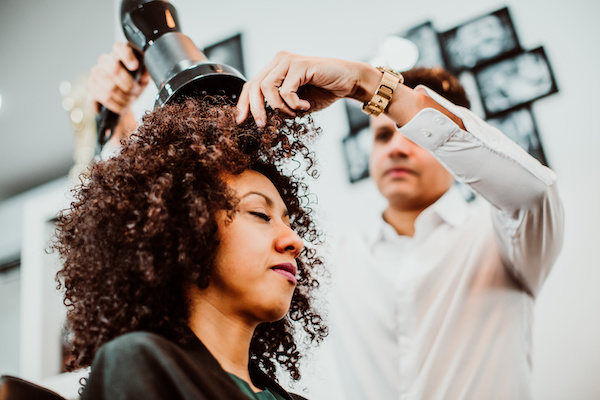
Bonding and reparative treatments can help with a range of damaged hair, but they can be even more important for curly and coily hair because if the hair isn’t properly treated, there can be a big impact on the overall appearance of the hair.
“When we’re looking at curly hair, there’s a much higher potential of breakage and damage,” says Wilde. “When we stretch the hair, even just from brushing it, there’s a risk of damage, and that damage in curly hair can translate to a lot of things, including frizz or a stretched-out curl pattern, which is very common.”
“Bonding services can be enormously beneficial because they can help achieve better curl formation, improve the hair’s elasticity and give the hair more strength,” she adds. “When you look at a client with straight hair, it’s much easier for them to disguise that damage and breakage compared to a client with curly hair, so this is a major component of what we can offer.”
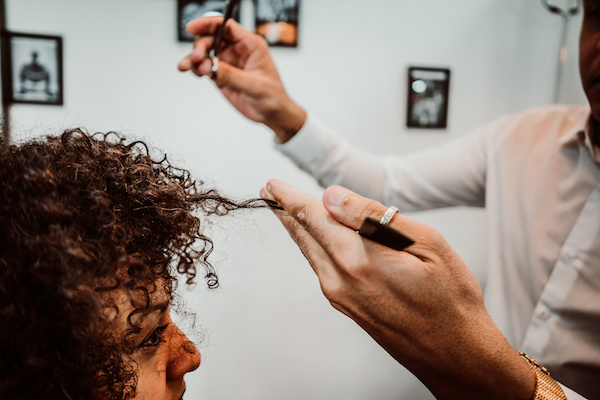
Another way to help curly-haired clients fight breakage is by encouraging them to come into the salon for regular trims to remove any split ends. In doing so, this can help keep your appointment books full.
It also goes without saying that many clients with curly hair are more susceptible to tangles, so being able to correctly detangle your client’s hair is vital to ensure that you’re providing them with a comfortable in-salon experience.
“A client with curlier hair will often have more tangled and dense hair, and sometimes you won’t be able to comb through it as easily,” says Duplantis. “Being able to understand their hair type and the amount of moisture you need to get through the hair is very important.”
“You always want to detangle the hair when you have slip and you never want to detangle the hair when it’s dry,” adds Takam. “This will cause breakage and be very difficult for you and the client. If I’m not detangling at the shampoo bowl, then I have a spray bottle and spray the hair with that or a leave-in, which makes it more manageable.”
“Prior to washing the hair, I would detangle,” she adds. “I like to wet the hair, apply conditioner and gently work from the tips and move my way up to the scalp. Sometimes, I start with my hands and then go in with a wide-tooth comb or curl-appropriate brush.”
“MORE PEOPLE ARE WANTING TO GO THE NATURAL ROUTE RIGHT NOW AND ARE EMBRACING THEIR NATURAL HAIR. AS SALON OWNERS, YOU CAN’T IGNORE CURLY HAIR ANYMORE. INVESTING IN THAT EDUCATION FOR YOURSELF AND YOUR EMPLOYEES IS ONLY GOING TO BE BENEFICIAL BUSINESSWISE.”— SANDRINE TAKAM, HAIRSTYLIST AND MATRIX ARTIST AND EDUCATOR, MONTREAL, QUE.
Product and Retail
All experts can agree that a large part of working with curly hair is educating your clients on how to style and care for their hair at home. Walking your clients through what products you’re using (and why) can be a great way to build trust and help your clients achieve in- salon results at home, all while helping to potentially increase your retail sales efforts.
“Sometimes, we get so lost in our craft, which is really important, but understanding what products we can recommend to our guests is the second part of that,” says Duplantis. “If our clients go home and can’t achieve what they’re looking for or what we did in the salon, they may lose trust in us. Being able to explain what products to use and how to use them to get the results they’re looking for will result in a client for life.”
“The knowledge on how to treat curly hair goes hand in hand with product knowledge and application,” adds Sherman. “Of course, product knowledge can help you sell products, which can add to the bottom line, but you’re also able to create better relationships with your clients.”
Wilde encourages stylists to carry a broad range of products that vary in price to be able to cater to a wide variety of clients and offer them products that not only work for their curl type and texture but also fit their budget. “Oftentimes, curly-haired clients are at a disadvantage because it can be harder for them to find a stylist and products that work for them,” she says. “They also use a lot more product, so they’re buying 70 per cent more products that are often more expensive than products made for straight hair. With the way the economy is going these days, it’s vital to have multiple price points available.”
“One thing I always say to stylists and salon owners is that curly-haired clients are your best retail clients,” adds King. “They will buy anything that makes their curls look beautiful, so when they trust you and your opinion and you give them the results they’re looking for, they’re ikely to purchase every product you [suggest] to them.”
Pricing
Just like any other salon service, pricing can vary based on skill level, products used, time spent in your chair and more, so when it comes to deciding on how to price your curly- and textured-hair services accordingly, experts agree that it can vary based on personal preference.
“Some stylists would suggest offering a higher rate on curly-hair services, and many people do,” says Wilde. “Having specialized in curly hair for over 13 years now, I could see stylists offering their services on a time-based approach going forward, and I think that’s a better way to price your services. Curly-hair appointments are going to take longer, but so can clients with straight hair that’s really dense, so I’m going to charge for the time as opposed to charging an additional rate because of the texture of their hair.”
“Curly-hair services take longer and are much more labour intensive,” adds Sherman. “We charge 25 per cent more for curly hair, but we’ve gone to a per- hour structure now because we find that different hair types and textures need different things. We can’t just have a flat rate for a haircut because one client may take an hour and another client may need three hours.”
Takam says it’s all about finding a fair balance that works for you and your business, and she prefers to have a variety of options available to her clients. “What I try to do now is have combo- based pricing rather than charging based on density and texture,” she says. “I base it on what the needs of that type or texture would be and what I think they need most, and I do this for all hair types. I also like to have some à la carte options, which I can adjust based on what the hair needs.”




Comments are closed.