

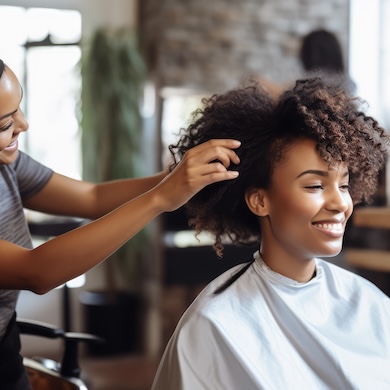
As many of us know, historically, a lot of beauty schools haven’t been as inclusive of curly textures as other hair types. As a result, many stylists graduate without knowing the basic fundamentals of working with curly hair.
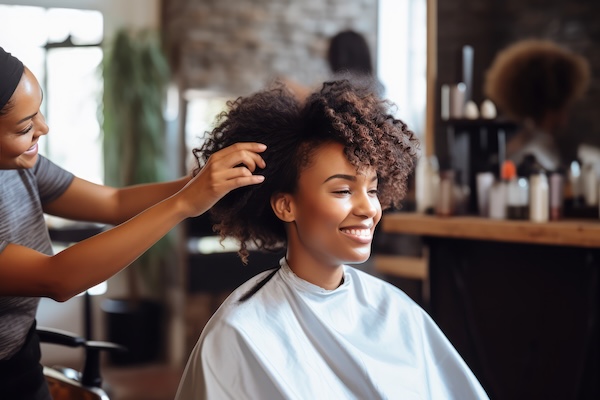
“In my day, there was zero mention of textured or curly hair [in cosmetology school],” says Steven Jensen, owner of Crown Curls in Vancouver, B.C, and an educator for Innersense Organic Beauty. “Along the way, I met a teacher who really took me under her wing and basically showed me the ropes of how I could apply a different set of techniques to curly hair.”
“There are huge gaps in hair school,” adds Nadine Bastien, a DevaCurl- trained, textured-hair specialist and owner of Curls by Nadine in Barrie, Ont. “They teach the basics, which is fine, but if you really want to learn anything deeper, you have to take courses. You will always have to be learning and improving, especially with curly hair.”
PRO TIP
CONSIDER REACHING OUT TO A LOCAL HAIR SALON OR ACADEMY THAT SPECIALIZES IN CURLY HAIR FOR TIPS ON HOW TO GET STARTED IN YOUR TEXTURED-HAIR EDUCATION JOURNEY. MANY ARE HAPPY TO SHARE THEIR KNOWLEDGE AND EXPERTISE.
Being Invested
For those who sought out the education earlier in their careers or are seeking it out now, some salon owners and hairstylists have made it their mission to close the skills gap and are inspiring others in the industry to follow suit. Now, as a curl expert himself, Jensen is passionate about sharing his skills to further educate others on working with curly hair.
“I think a lot of the reason why was because of my own personal experience with having curly hair myself,” he says. “I never understood the traditional constructs of hairdressing because, to me, I just never saw how I could apply the same techniques to textured hair.”
“Once I started implementing that into my craft, I realized that this is very different, and this is something that I can do very well,” he adds. “I just realized that if I apply these skills to a different fabric and have a slightly different approach, I can offer something totally different.”
Even for those genuinely interested in advancing their education to learn how to work with all hair types, hands-on earning opportunities for textured hair were few and far between, especially in Canada.
“Back then, there were no classes happening in Canada for this,” says Jensen, who adds that, while it has improved over the years, the U.S. continues to remain a hub for textured- hair education opportunities. “That’s been a huge gap for people. If you really wanted to understand that fabric and hair a little bit deeper, it would require travelling and investing a lot to get that knowledge.”
For Abisara Adouko, founder of Inhairitance Curl Spa and Inhairitance Academy in Montreal, Que., she wanted to do her part to help bridge the geographic limitations and financial hurdles around texture education for her stylists.
“Every hairdresser that starts with the Curl Spa comes from standard hairdressing education, which has nothing to do with curly hair,” she says. “We created a whole curriculum for all of our in-house hairdressers to actually provide them with the methods, techniques and skill sets, along with theoretical knowledge about the science of curly hair. Since then, we’ve seen more demand for it from other hair salons and schools.”
“THE TRENDS ARE CHANGING, BUT ALSO THE NEEDS ARE CHANGING. YOU WANT TO STAY ON TOP OF YOUR GAME.” — ABISARA ADOUKO, OWNER OF INHAIRITANCE CURL SPA AND INHAIRITANCE ACADEMY IN MONTREAL, QUE.
Getting Started
For stylists looking to better serve curly- haired clients, the first step is often the most important one: a commitment to learning. “I always want to be better,” says Bastien. “I’m always thinking, would it make my clients happier? What kind of value would it bring to my clients? I don’t necessarily think about what value it would bring to me and my business— it’s more about how I can make my clients happier. And it’s always with education.”
When there’s a lack of local resources and an abundance of options available online and internationally, understanding where to begin is also key.
“There’s so much information out there, but it doesn’t mean that it’s the right information,” says Bastien. “I feel like curl typing is one of those things where there’s a lot of misinformation and things get misconstrued really easily. Clients will come in after they’ve been told one thing about their hair, but their hair is completely different.”
“The education is there, in terms of the practical, but there’s not a lot of theory behind it,” says Elisha Gotha, owner of The Curl Lounge in Toronto, Ont. “A lot of stylists don’t really understand the deep narrative that’s behind textured hair, especially tighter textures.”
Gotha is also a texture ambassador for L’Oréal Canada’s Power of the Collective, an online education platform that is open to Canadian hairstylists and offers free learning resources for all hair textures.
“Curly-haired and textured-hair people haven’t always been represented in professional haircare,” she says. “There’s been a huge gap, but I’m also seeing that it’s starting to come a long way. Brands are starting to really pick up on that.”
To help bridge the gap, some curly experts, including Gotha, have taken it upon themselves to share their knowledge and help educate both the next generation of hairstylists and those who have been working in the industry for a long time.
“I actually started Txtūr Academy this year,” she says. “It’s something that I really feel dedicated to because I just feel like there was a huge gap in formal education out there. For me, being a stylist who’s been in this industry for the last 20 years—and specifically doing curly hair—there really hasn’t been anywhere for me to go in Canada for education. It made me really want to get into that space where I’m educating.”
In addition, Gotha has been working with Marca College to help new stylists have a stronger foundation and skill set for working with all hair textures “so that when they are working in the salon space, they’re set up for success.”
“IT’S SO VALUABLE TO CONSTANTLY TAKE NEW CLASSES AND IMMERSE YOURSELF IN NEW APPROACHES.” — STEVEN JENSEN, VANCOUVER-BASED OWNER OF CROWN CURLS AND AN EDUCATOR FOR INNERSENSE ORGANIC BEAUTY

Building a Clientele
Building a strong and loyal base of textured-hair clientele starts long before they sit in your chair. It begins with setting the tone for trust, transparency and a clear sense of identity in how you run your business.
“What has worked really well in my business and salon is just setting a particular standard and a boundary for your standard,” says Jensen. “As for how you want your salon to operate, it’s super important to be genuine and really just carry out your business the way you want to.”
For instance, in his salon, Jensen is very clear in the consultation process about the types of services offered and is keen to refer to other professionals when needed, ensuring that mutual respect and alignment are there from the start with each client.
“It’s really important to honour the way you work and be true to your skill set and what you do,” he says. “And if there’s a request that makes you feel uncomfortable for whatever reason, it’s OK to say no. I think clients really appreciate that more than just going for it when you know that this is not something that is your specialty.” For some clients, especially within the textured-hair community, the salon can be a place that lacks trust.
Whether it’s from a past experience or a lack of understanding, building that relationship is key for many clients. “I’ve always had a really good clientele,” says Bastien. “My clients always tell people where they go. When you do a good job with your curly-haired clients, they will sing your praises.” Adouko notes that, over time, as embracing natural texture has become more popular, clients have also shifted, which means that techniques and products must shift, too.
“CURLY HAIR IS BECOMING TRENDIER, SO THERE ARE A LOT MORE RESOURCES FOR PEOPLE COMING INTO THIS INDUSTRY. EVEN IF YOU JUST TAKE A ONE-DAY COURSE, IT’S ONE STEP IN THE RIGHT DIRECTION TO A CAREER OF LEARNING.” — NADINE BASTIEN, A DEVACURL-TRAINED, TEXTURED-HAIR SPECIALIST AND OWNER OF CURLS BY NADINE IN BARRIE, ONT.
“Clients have changed a lot from mainly type 4 hair, with a lot of people from the Black community, to all communities,” she says. “[Everyone is] celebrating their curly textures now. Because of that, we have to offer a lot more hair products.”
She adds that, in the past, pomades and shea butter were often used, with oils and creams being the go-tos that stylists would reach for. Now, with a high demand for products that are versatile for a wider range of textures, there are more products that are lightweight, as well as different textured gels.
As stylists expand their toolkits to cater to a diverse range of clients, their service prices can rise, too. But there are also additional benefits on the overall ticket.
“For curly hair, products are a must,” says Adouko. “That means they’re a clean revenue stream, and that’s a dream. You can add to your average ticket price by providing them all of the products for their at-home care. It’s so important to invest in product knowledge because you’re able to educate your clients better.
PRO TIP
IN ADDITION TO LEARNING THE SKILLS YOURSELF, YOU CAN SHARE YOUR KNOWLEDGE WITH YOUR TEAM TO CREATE A DOMINO EFFECT WITHIN YOUR SALON.


Comments are closed.