


As the old adage goes, “Many hands make light work,” and the salon environment is no exception. From answering phones to sweeping the floors to shampooing and blow-drying hair, salons often require extra sets of hands for day-to-day tasks to make everything run smoothly.
While new stylists may be anxious for the opportunity to work on the floor, offering apprenticeship and mentorship programs that teach hands- on skills can help aspiring hairstylists build confidence and help their careers flourish at a faster pace, which ultimately benefits salon owners and their teams.
“In terms of adding or retaining team members, having our apprenticeship program and growing young talent beats hiring externally by 50 per cent, if not higher,” says Bruce Peters, owner of Zazou Salon & Academy in North Vancouver.
“It’s always important to have new talent coming in,” adds Spenser Tsinokas, salon director of Valentino’s Grande Salon in Whitby, Ont. “There are always going to be stylists who quit, go on mat leave or decide to work part time, so from a business perspective, you’re always looking to make sure you have enough staff to take care of your clients.”

Make Some Noise
When it comes to encouraging new talent to join the industry, Peters says finding students for his academy has been a challenge. As a result, he believes that salons (and the industry as a whole) should educate communities about the benefits of being a hairstylist.
For this reason, his salon has participated in several career fairs to shed light on hairstyling and teach younger generations about what it means to work in the industry. “Some people still think it doesn’t require brains to get into hairdressing, but I think we’ve debunked that stigma,” says Peters. “You can make a fantastic amount of money in this industry—for example, you can make $100,000 a year with six weeks of vacation while working only four days a week. We need to start talking about it more in schools and in our local communities.”
While Tsinokas believes the industry can benefit from educating others on pursuing a career in hairstyling, she has noticed more teachers talking to students about getting into the trades.
“I think the industry has changed a lot,” she says. “Personally, we’ve noticed a big difference in the number of schools offering hairstyling programs, and since we know hairdressers tend to have that passion from early on, we do a lot of work with the local schools in our area. We bring our stylists in and teach classes so that we can educate new apprentices and stylists.”
Speed of Lightning
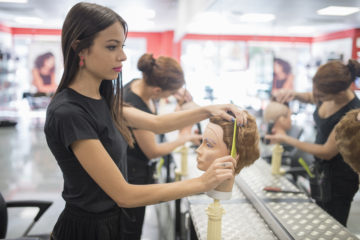
Oftentimes, people looking to get into apprenticeship programs are deterred by the idea that they will not be doing hands-on learning. This is why Peters believes in the importance of allowing apprentices to dive right into the learning experience and start working with hair after only a few weeks of being in the salon. “We want to make sure they have their hands in hair within a couple of weeks,” says Peters. “And when I say ‘hands in hair,’ I mean more than just shampooing hair; I mean colouring hair and learning how to cut hair.”
“It’s definitely very important for them to get hands-on experience, so we have an assistant program in our salon as well,” adds Tsinokas. “Anyone who is in hair school or thinking about hair school can sign up as an apprentice before they even start the school program.
That way, they’re learning how to apply toner, shampoo hair and learn about formulas before they go to school. I’ve seen it make a huge difference. They seem to absorb the information so much more because they’ve been in the salon environment and are seeing and working in it on a daily basis. We’ve noticed a huge difference in those who start their apprenticeships.”
“We love seeing people who started out as new talent in our training program become senior and master stylists,” she adds. “It’s a source of pride for everyone involved. Because they started at such a young age or at a lower level, they really feel that pride when they work up to those higher levels.”
While having apprentices in the salon can benefit both staff and clients, Peters says they can help the salon in the long run by speeding up future hiring processes when they want to fill a position. Allowing apprentices to get to know the routine right away gives salon owners the option to hire someone internally. “When we take on people who have graduated from an accredited school, it’s fantastic being able to see them come out of that environment with little confidence in their skills and then go on the floor with a tremendous amount at the end,” says Peters. “They really shine after a period of time because they understand both soft skills and hard skills.”
With constantly changing hair trends and demands, it’s important to provide new talent and apprentices with enough motivation to grow their skills regularly. “Trends are constantly changing in the industry, so it’s really important to keep up on education, not only for new talent but also for seniors and masters,” she says. “It keeps them passionate and motivated to learn new things so that they never feel stagnant.”
While offering an apprenticeship provides a learning experience for new talent, Tsinokas and Peters believe that it’s a mutually beneficial relationship. “We couldn’t run without our apprentices,” she says. “They help make sure our clients are having a great experience and keep our stylists on time by offering them assistance in different areas.”
“We can’t survive without our apprentices,” adds Peters. “They’re a vital part of our organization. It’s a two- way street. Stylists foster people, but having an effective personal assistant can increase stylists’ income by 30 to 50 per cent. I think all hairstylists should have one if they’ve got the support and demand.”
“IT BUILDS A LOT OF TRUST AND COMMITMENT IN YOUR SALON AND YOUR TEAM WHEN YOU PUT ALL THAT MONEY AND EDUCATION INTO A NEW STYLIST. THEY CAN SEE THAT YOU REALLY VALUE THEM BY MAKING THAT INVESTMENT, AND I THINK IT REALLY BUILDS A STRONG FOUNDATION FOR A RELATIONSHIP THAT LASTS.” —SPENSER TSINOKAS, SALON DIRECTOR OF VALENTINO’S GRANDE SALON IN WHITBY, ONT.
Getting To The Root Of It
For hairstylists who have chosen to leave salons and go freelance or work independently, Peters says they don’t always fully understand what comes with being their own boss and managing everything on their own.
“Whether it’s managing their own business, owning their own space, renting a chair or opening a business, a lot of them aren’t equipped to do that,” says Peters. “They don’t have the willingness or the determination to do it.”
In addition to fully communicating with hairstylists who are looking to explore the freelance route, Peters uses payroll projectors and calculators to make stylists aware of what it truly means to be independent. “This strategy also helps them realize if they will make more money if they leave the salon,” he says.




Comments are closed.