


Over the past few years, manufacturers and distributors have been working overtime to keep up with the demands of hairstylists and beauty pros while finding innovative ways to deliver top-notch education across Canada.
With the evolution of virtual learning since the pandemic, education is now available in a wide variety of formats, on a range of platforms, and can be accessed any time.
“We’re recognizing that the amount of time that stylists can commit—or are willing to commit—to education, as well as how they take in education, has changed,” says Katrina Smiley, education director for Redken Canada.
“Now, there’s a huge focus on shorter segments, and we’re really trying to make training as efficient as possible so stylists can get a lot out of short sessions of education. There’s always going to be a need for immersive, full-day learning, but stylists don’t have the ability to commit to large amounts of time, so I think that, overall, education is becoming more efficient.”

Elevating Through Education
Today, clients can find an infinite number of hairstylists and salons with just the click of a button. Combining this with the fact that various trends pop up on social media so frequently, the need for innovative and accessible education is more important than ever.
“Education in the hair industry is one of the most crucial things,” says Deanna Spielman, education leader for Wella Canada. “Clients find things online and they want their hair to look like what they see. If their stylist isn’t growing their capabilities and their craft, they can’t deliver what their clients are looking for.”
In addition to trends, techniques and styles changing, the stylists who are seeking out new education pathways are changing. As a new generation of hairstylists enters the industry with new ideas and goals, education has to change right along with it.
“When we look at the different generations coming into the industry, we’ve noticed an evolution in the millennials, Gen Zers and zillennials,” says Joshua Balint, national education and events director for Matrix Canada. “The way that they learn is different, so I think education has to adapt with them but still not forget the previous generations. If we don’t move with them and how they want to be taught, we’re doing them an injustice.”
Virtual
Digital
While virtual education has been around for quite some time, it’s catapulted in popularity since the start of the pandemic, when it was the only option for learning due to travel and gathering restrictions.
A key takeaway has been the convenience of virtual education for learners to be able to access education at their own pace while removing barriers associated with in-person education, such as cost, travel and time.
“The system we had before still works, but we looked for an opportunity to expand that,” says Balint. “We’re not looking for digital to replace in-person education because it’s very important and we still need it. Where we can grow is being able to connect with more people, and that’s where digital comes in. We can reach more people and we can have more touchpoints with our community. Sometimes, a stylist may only be able to afford one in-person class, but with digital, they may be able to afford more, so it’s really about having a hybrid approach.”
With the increased cost of living and salon business expenses on the rise, it can be hard for many hairstylists to set aside money for education. Balint says Matrix created its Mentor Me program, which gives hairstylists and students an opportunity to learn from some of the brand’s leading educators, to help break down those barriers.
“Whether you work with [Matrix] or not, the idea is that we really want to elevate the industry,” he says. “With this program, every stylist and every student is welcome. You just sign up and get tips, tricks and education about different trends. There are many branches to it. We have our regular Mentor Me, which is for a smaller group, and our Mentor Me for All, which is for as big of a group as we can get. We also had our Mentor Me Educator and Beauty Builder programs.”
With the use of virtual platforms on the rise, there are many different places that stylists can go to find education. From brand and distributor websites and YouTube to social media platforms (such as Instagram, TikTok and Facebook) and video communication platforms (like Zoom and Microsoft Teams), the options are endless.
“The education that we provide online is live, so any stylist from any salon can jump onto Eventbrite and register
for one of our online classes for free,” says Smiley. “Every quarter, we have 14 colour webinars, so those are all about hair colour. We talk about what’s new and what’s trending in the industry, and stylists can come and learn about our new launches and upcoming events, as well as new trends. We also have four business webinars that educate stylists on how to retail and grow their social media and offer monthly texture upskilling, so our virtual classes are an easy resource that stylists can go to at any time and get upskilled.”
In addition to virtual classes offered directly from manufacturers, distributors have expanded their educational offerings to include digital opportunities, allowing stylists from across Canada to access their classes.
“We host virtual classes for areas that are more remote and don’t have local educators,” says Lisa Bremner, director of education at Toronto Barber & Beauty Supply’s Liquid Luxuries division. “Those are done on request and through Zoom, so we feel out what the needs are and offer virtual classes.”
While many stylists are familiar with the traditional formats of virtual education, in recent years, some brands have continued to think outside the box when it comes to ways to provide education to stylists digitally.
MATRIX’S LATEST MENTOR ME FOR ALL INCLUDES ITS MATRIX IN THE METAVERSE SUMMER HAIR CAMP, WHICH INCLUDES FREE VIRTUAL EDUCATION SESSIONS IN JULY WITH EDUCATORS HAROLD GONZALES, HEIDI KENNEY AND MARTIN MENARD!
“THE ONLY DIFFERENCE BETWEEN YOU TODAY AND THE FUTURE VERSION OF YOURSELF IS HOW MUCH YOU INVEST IN YOUR EDUCATION.”— KATRINA SMILEY, EDUCATION DIRECTOR, REDKEN CANADA
Last year, Matrix launched Matrix in the Metaverse to coincide with one of its colour launches, with an aim to reach and engage hairstylists and colourists in a brand new and exciting way.
“In a traditional webinar, a stylist would attend a class and you would have a facilitator who would share their screen and talk through the education,” says Balint. “Matrix in the Metaverse brings a different experience. You get to visit different areas, watch videos and visit booths whe you can talk one-on-one or in a group with our educators, and we even have a stage where you get your full classes. You get to create an avatar for yourself and it removes that awkward barrier where you might be embarrassed to ask a question.”
Social Media
In addition to more structured virtual education classes and webinars, social media has increasingly become a place where stylists can turn to for quick and easily accessible education, colour formulas, tips and tricks and more.
“Looking at our industry today, a big thing right now is really quick and eye- catching education,” says Spielman. “We try to provide snippets of learning in a short time frame. Our field education trainers do a lot within our education, but they also create a lot of content for social media.”
“I look at education almost like food,” adds Balint. “Sometimes you want a full meal and other times you may just want a snack. When I look at education on social media, it’s snackable content: something short because you might not have time to sit there for 20 minutes, and it comes down to quality over the length of time.”
“WITH DIFFERENT TYPES OF EDUCATION OUT THERE, WHAT WE’RE TRYING TO DO IS NOT LEAVE A STONE UNTURNED WHEN IT COMES TO HOW PEOPLE LEARN.” — JOSHUA BALINT, NATIONAL EDUCATION AND EVENTS DIRECTOR, MATRIX CANADA
Mobile Apps
As more people rely on mobile apps to access information, there have been an increase in education apps launched by manufacturers to keep hairstylists and beauty pros equipped with everything they need to access learning 24/7.
“We have our app-based education, and it can be used as a tool to find a variety of different education offerings,” says Spielman. “There are videos and technical guides, and if you’re someone who likes to self-direct your learning, you can go in our app and download the content and use them at your own pace.”
“All of [the L’Oréal Group’s] brands share one app [called Access], and they upload their own education videos on new launches, how-tos, key insights, business-building tips and subjects like the foundations of hair colour,” adds Balint. “Apps can be educational playgrounds, and they’re almost like the Netflix of education. With our app, what’s great about it is that you can look up education by category and you can even filter the results by brand so you can really customize your journey.”
While colour education can be one of the more difficult types to learn virtually, another manufacturer that is utilizing an app for this is Moroccanoil. Earlier this year, they relaunched their Color Destination app, which offers a range of education options, including videos, reference guides and self-guided learning on topics like colour theory, product application and more. The Color Destination app also allows users to upload their own looks, connect with the brand’s stylist community and earn badges that can be redeemed for products, merchandise and more education from the brand.
In-Person

REDKEN FUSION IS RETURNING FOR ITS SEVENTH EDITION AND WILL BE HELD AT THE SHERATON CENTRE TORONTO HOTEL FROM OCTOBER 27 TO 29. THE THREE-DAY EDUCATIONAL EVENT WILL FEATURE A RANGE OF SEMINARS—ON TOPICS SUCH AS HAIR COLOUR, CUTTING, STYLING, TEXTURE, BUSINESS AND SOCIAL MEDIA—AND WELCOME ATTENDEES FOR A VIP COCKTAIL PARTY, GRAND OPENING EVENT AND SEATED GALA DINNER, AS WELL AS THE BRAND’S ELECTRIC FESTIVAL
Classes
Above all, the benefits and demands for in-person education continue to grow. In addition to being something that people longed for during the pandemic, it continues to be the number one way to learn and retain new skills.
“We have a career path offering, which is a process and a journey that I went through myself,” says Smiley. “We help stylists get educated and trained in the skill set that they want to grow. Then, we help to create experts in salons through ambassador and specialist programs, and we create really proficient Redken specialists, who help train and upskill stylists in their salons.”
“Then, we have brand advocates, which are stylists that we bring in for more exclusive trainings to help elevate their careers,” she adds. “After that is our certification, which is like helping stylists get their PhD of colour or design. This is something that really helped me market my business and attract clients who are looking for the very best in the industry.” Smiley adds that Redken also offers an artistry program, which enables stylists to educate, mentor and coach other stylists behind the chair.
In addition to having their academy, Wella Studio, in Toronto, Spielman says it’s still important to offer education in different locations to continue to make it accessible to more people. “We know that, with the size of Canada, it might not be feasible for someone from western Canada or Quebec to get to our studio,” she says. “Because of this, we offer education at what we call ‘satellite’ studios or locations, and we like to send artists or trainers to those locations so we can bring the education to them instead of making them pay the travel costs and having to take days away from the salon.”
Working with their distributors is another way for manufacturers to continue to offer education to the masses. “We work closely with the manufacturers to help them provide their in-salon trainings,” says Shannon Baribeau, education coordinator for Modern Beauty Supplies. “In places where we don’t have an academy, we work to find venues, such as a hotel or salon that’s large enough and willing to accommodate, and we host the education there.”
DID YOU KNOW? THE KAO SALON ACADEMY IN TORONTO IS CELEBRATING ITS FIFTH ANNIVERSARY THIS YEAR! THEY ARE HOSTING A WIDE RANGE OF CLASSES ON HAIRCUTTING, COLOUR, BLONDING, FOILING, FINISHING, SOCIAL MEDIA, CONTENT CREATION AND MORE, FEATURING ARTISTS AND EDUCATORS FROM THEIR BRANDS, INCLUDING GOLDWELL, KMS AND MORE.
Academy
Attending a class (or classes) in person at an academy can be a great way to connect with other stylists in your area and may even be able to provide you with an extra dose of inspiration.
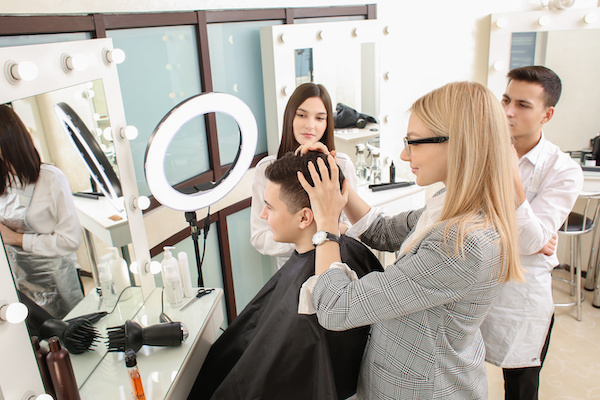
“At our studio in Toronto, everything that we do is hands-on,” says Spielman. “It’s either hands-on model workshopping or mannequin workshopping and, depending on the class, it’s always stated if you’re going to be working on live models or mannequin heads. I think that’s a huge piece because, virtually, you’re just watching. Everyone is a different type of learner, and if you are a tactile learner and want to be able to touch and feel, hands-on education is really important.”
“We currently have six academies that are located in four different provinces, so we’re able to have classes at each of those locations,” says Baribeau. “Our classes here include barbering, extensions, colour and even smoothing treatments, and we have different class options like hands-on and look-and-learns. We find out from our sales reps the education that stylists are looking for, and that’s how we decide on the classes we offer for that particular season.”
“We have look-and-learns in the morning, where we can accommodate 20 or 30 stylists. And in the afternoon, we do hands-on classes, which are cut down to 12 stylists,” adds Bremner. “We just continually have classes that we invite our salons to, and we like to make it as affordable as possible by giving them different scholarship promotions, where their purchases go toward getting free education.”
Hair Shows and Events
The landscape of in-person hair shows and events in Canada has changed drastically over the past few years, but there are still plenty of options out there for stylists who are looking to access education and inspiration on a larger scale.
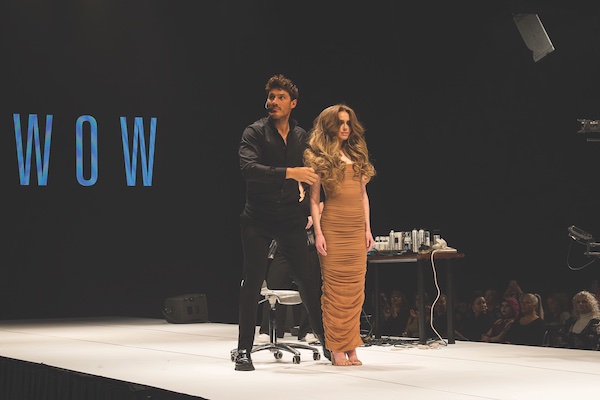
CELEBRITY HAIRSTYLIST CHRIS APPLETON ONSTAGE AT THE 2023 MODERN ROCKS THE RUNWAY SHOW IN CALGARY, ALTA.
“Distributor events bring everyone together,” says Baribeau, who reflected on Modern Rocks the Runway, which was held last October. “Our event allows stylists to interact and learn about brands that they haven’t seen or worked with before. It makes them feel like they’re part of something a little bit bigger than their salon.”
“At Modern Rocks the Runway, stylists get to see all of the styles and trends but on a larger scale because it’s such a big event,” she adds. “We decided to bring back a show that was all about the education and the hairstylists, not just about getting good deals on products, because there are no [product] sales at the shows.”
In addition to events hosted by distributors, more manufacturers are back to hosting their own individual events. “If a stylist lacks inspiration and feels like they’ve been doing the same thing for a long time or lacks motivation, an event like Redken Fusion is made for them,” says Smiley. “We always bring in new artists and educators and cover a lot of different topics. It’s an opportunity for Canadian stylists to have access to educators that have never been to Canada before.”
“Events like this give you an escape from the day-to-day and really allow you to be in this creative place,” she adds. “As a hairstylist myself, we’re so committed to our clients and driving our businesses, families and employees. These events allow us to reinvest in ourselves and maintain our creativity and inspiration.”
In addition to providing stylists with inspiration, hair shows and events enable them to connect with one another and allow for a more personal take on education.
“We do Wella-specific events, and you’ll see those pop up a little bit more,” says Spielman. “We want to inspire,
and we want to create a community among hairstylists. We want them to be able to connect with one another and work through solutions together. We also choose to be part of our distributor partner events to support them.”
“We host events because they allow stylists to get to meet artists and educators that work with specific brands,” adds Bremner. “It offers that person-to-person contact that I think we didn’t realize we needed so much until we couldn’t have it. It also helps us and our educators build a relationship with stylists, and it allows stylists to put a name behind a family-owned business. It’s another great connection point.”




Comments are closed.